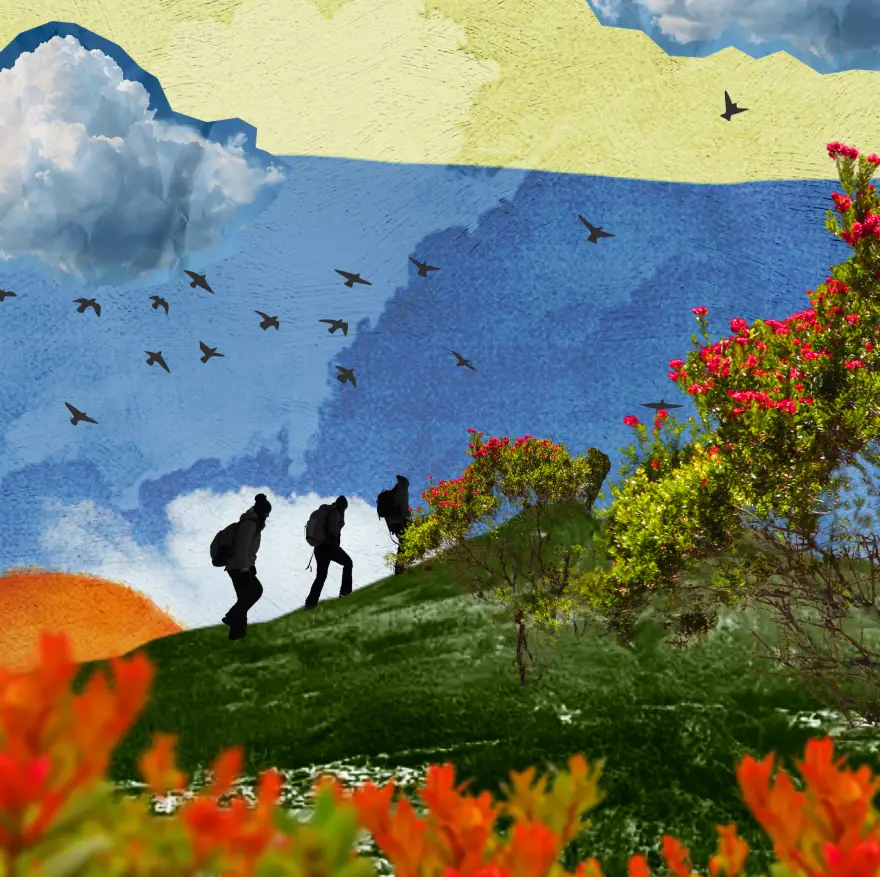
Expedition to Study Cantigi Above the Clouds
31 January 2026
The UMS research team climbed Mount Lawu to explore cantigi. An endemic plant containing anti cancer compounds.




The Ministry of Communication and Digital (Komdigi) has temporarily suspended access to Grok on X in Indonesia. This decision followed reports of Grok being misused to generate fake pornographic content over the past several weeks.
Minister of Communication and Digital Meutya Hafid, in an official statement, said the decision was taken to protect women, children, and the broader public from the risks posed by fake pornographic content. The Ministry has also urged X to immediately come forward and provide clarification regarding the negative impacts of Grok’s use.
“The government views non-consensual sexual deepfake practices as a serious violation of human rights, dignity, and the security of citizens in the digital space,” Meutya said, as quoted from the Kemkomdigi website, Monday (19/1/2026).
Grok is an artificial intelligence (AI) feature on the social media X, formerly Twitter. It is used to respond to conversations, understand questions, and generate answers for X users. Most recently, Grok has also introduced an image manipulation feature, commonly known as deepfake.
Read more: Deepfake: A Weapon of Mass Deception in the 2024 Election?
This image manipulation feature has reportedly been misused by some users to generate pornographic images. The case began when several netizens shared photos on X and tagged Grok, requesting pornographic edits.
The case eventually reached the attention of the Director General of Digital Space Supervision at Kemkomdigi, Alexander Sabar. Preliminary findings by Kemkomdigi indicate that Grok AI does not yet have explicit and adequate safeguards to prevent the production and distribution of pornographic content based on real photographs of Indonesian citizens.
“This poses a risk of serious violations of citizens’ privacy and rights to personal image,” Alexander said, according to the Kemkomdigi website, Tuesday (20/1/2026).
Indonesia and Malaysia have become the first countries to block Grok. According to Gunawan Ariyanto, S.T., M.Comp.Sc., Ph.D., a lecturer in Informatics Engineering at Universitas Muhammadiyah Surakarta (UMS), the Indonesian government’s decision to block Grok was appropriate.
“In my view, it was a very appropriate decision. Especially since several other countries have also raised similar objections,” Gunawan said in an interview, Wednesday (21/1/2026).
Since early January 2026, a number of public figures in Indonesia have actively voiced protests over the misuse of Grok on X to generate obscene content. Protests have also emerged from several countries, including the European Commission, the United Kingdom, France, Brazil, Turkey, and India. Public figures from those countries have likewise experienced similar cases involving the misuse of their photos without consent.
Gunawan stated that such misuse is indeed difficult to avoid when viewed from the perspective of AI capabilities. However, stricter government regulation can be prioritized to reduce the risk of such abuse.
Several countries, Gunawan noted, already have ethical standards governing the use of AI. Complaints submitted by a number of countries to Grok’s developer and to the X are one way of enforcing those ethical standards. “Developers should indeed comply with regulations. They should not look for loopholes,” he asserted.
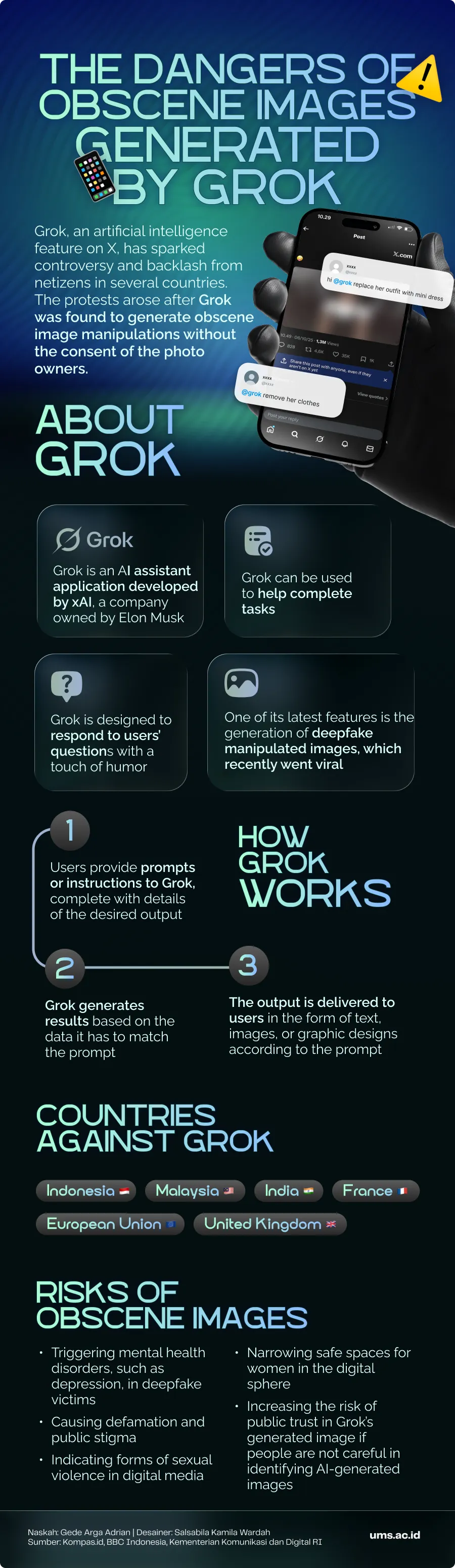
Gunawan explained that images generated by Grok are fake. Users typically provide prompts to Grok describing the desired outcome of the image manipulation. Grok then produces images based on the data it possesses. “The additional elements resulting from Grok’s manipulation are not real images from human life,” he said.
Despite being fake, Gunawan emphasized the potential negative impacts arising from the misuse of Grok. Victims of such misuse face the risk of depression and mental health disorders.
“Grok’s manipulated outputs can cause stress. Even if the image is fake, suddenly seeing it appear can still be distressing,” Gunawan added.
Images generated by Grok also have the potential to become defamatory and provoke public backlash. According to Gunawan, this risk is exacerbated by Indonesia’s low level of digital literacy. This condition often makes it difficult for the public to distinguish between AI-generated images and real photographs.
The government must take serious steps to prevent more severe impacts of AI misuse, especially as some AI developers have begun introducing adult-specific modes. In mid-December, ChatGPT was reported to be preparing an adult mode that will begin implementation in 2026.
Gunawan urged the government to seriously anticipate the risks of more severe AI misuse. Filtering which AI features are permitted for use in Indonesia is one way to prevent future abuse. This approach is feasible because AI technology can be customized based on the country in which the service operates.
“Of course, this must be accompanied by strict monitoring by the government, so that when cases occur again, the government can take immediate action,” Gunawan concluded.
Writer: Gede Arga Adrian
Translator: Farizal Luqman Majid
Editor: Al Habiib Josy Asheva
The UMS research team climbed Mount Lawu to explore cantigi. An endemic plant containing anti cancer compounds.
Nothing’s more special than reading curated news just for you.
Subscribe to the UMS Newsletter for free today.