
Diabetes Now Threatens Working-Age Adults
4 February 2026
Young people are no longer immune to diabetes. An unbalanced lifestyle has led many to be diagnosed only after serious complications have already set in.




Social media platforms such as X remain a popular space for netizens to express opinions or criticism toward certain parties. This habit often spreads, drawing more people to join in with similar comments.
Several cases even escalate into full-blown crises when netizen reactions become uncontrollable and spread across other platforms like Instagram or Facebook. Lecturer of Communication Sciences at Universitas Muhammadiyah Surakarta (UMS), Dr. Dian Purworini, S.Sos., M.M., explained that such situations can occur when the targeted party fails to respond positively to the public’s opinions.
“When public opinion cannot be responded to in a positive way, and it creates disappointment among the public, the issue can grow rapidly because of social media, especially X, making it increasingly difficult to control,” Dian said when met in her office, (8/12/2025).
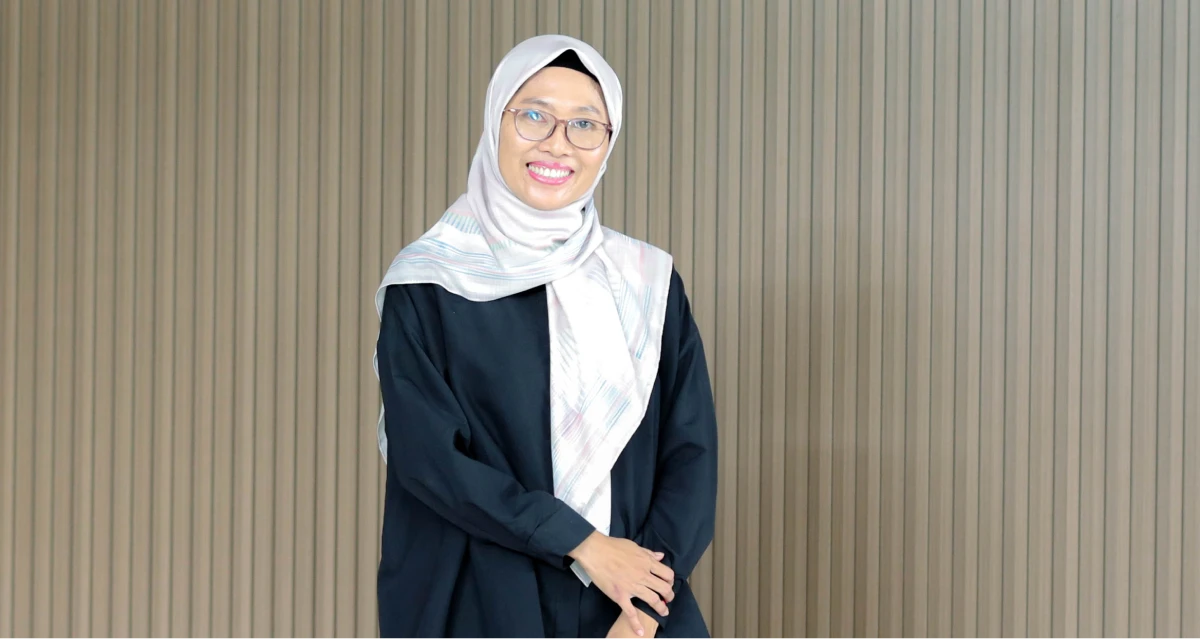 Dr. Dian Purworini, S.Sos., M.M. UMS PR/Luqman Hakim
Dian pointed out that a case of this kind happened to the popular beauty brand Whitelab at the end of 2022. At the time, Whitelab held a fan meeting with Oh Sehun, member of the music group EXO, at Central Park Mall, Jakarta. Naturally, the event drew massive enthusiasm from Sehun’s fans, who flocked to the West Jakarta shopping center.
The fan meeting, held on 6 November 2022, triggered a wave of negative comments on X. The overwhelming number of fans caused Whitelab to struggle in managing the crowd.
Chaos also broke out when VIP ticket holders were unable to meet Sehun, despite the promised face-to-face session being one of the benefits of the VIP package.
Netizens’ anger intensified when they discovered a comment from a Whitelab representative that was deemed unethical. “There are plenty of people like this in PIK (Pantai Indah Kapuk)…” read a remark from one of the event committee members that circulated on X.
Not only that, the Whitelab team also posted a photo of themselves posing with a bouquet of flowers gifted by fans, flowers that were originally intended to be given to Sehun.
The chaos inevitably drew harsh criticism from Sehun’s fans on X. The hashtag #whitelabapologize, along with a flood of furious comments, dominated the platform’s timeline.
Dian Purworini, together with two lecturers from the Faculty of Communication and Informatics at UMS, Rona Rizkhy Bunga Chasana, S.I.Kom., M.A., and Dimas Aryo Anggoro, M.Sc., then analyzed the netizens’ comments on X related to the Whitelab case.
In total, they gathered 7,224 tweets posted between 7-10 November 2022. Of these, 4,992 were negative, 450 were positive, and 1,782 were neutral.
Dian then used sentiment analysis to classify the emotions expressed by netizens into three categories: positive, negative, and neutral, an approach that is rarely applied within the social sciences.
“This sentiment analysis actually belongs to the field of informatics engineering,” she said. However, this method was chosen because it can process an extremely large volume of public comments quickly.
From the analysis, Dian observed that the anger expressed by netizens arose because the mistake made by Whitelab could have been prevented with proper preparation. The public expects a high level of accountability for such an error. “If it couldn’t have been prevented, of course the attribution would be different,” Dian added.
Dian later published the study titled “Public Opinion Towards Organisational Crisis: Insights from the Cognitive Appraisal Theory” in Sage Journals in early May.
The case experienced by Whitelab is one of many public crises faced by companies or organizations in Indonesia. Dian believed crisis communication is a crucial skill for organizational communication professionals.
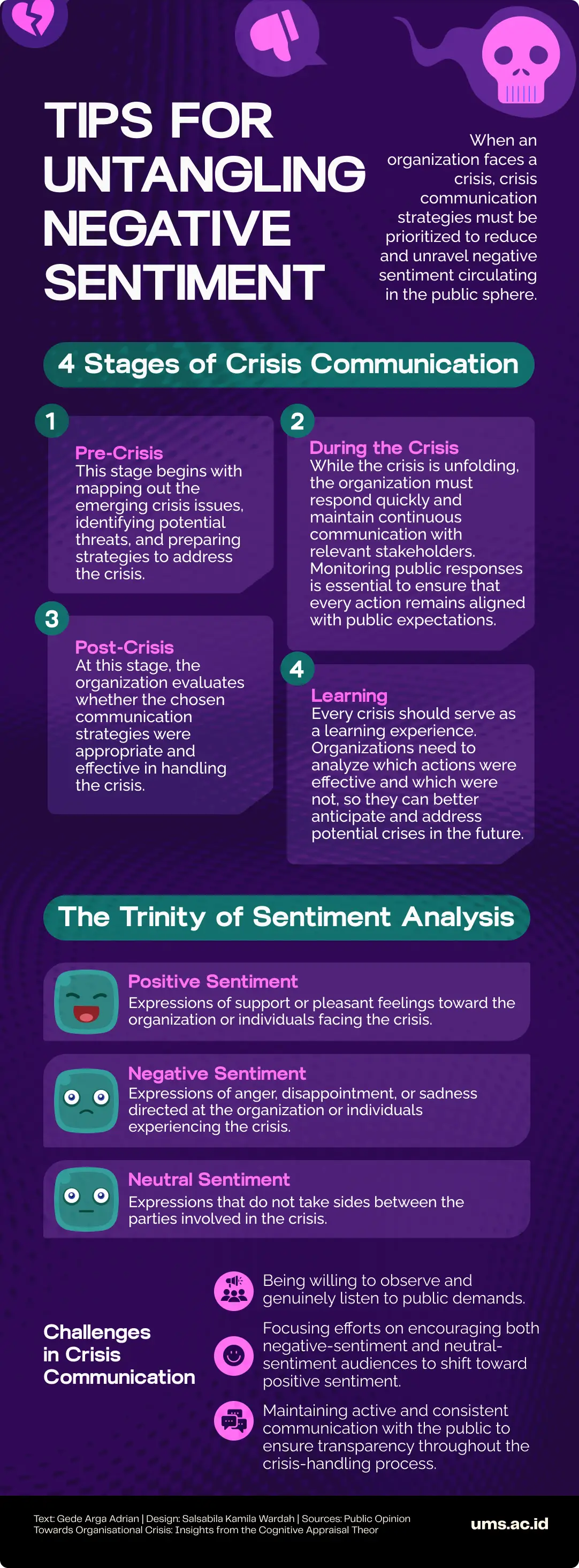
Crisis communication is a response given by an organization before, during, and after a crisis. This communication process is part of the organization’s effort to bridge communication with the public and its stakeholders.
“This crisis communication is the crisis perspective from the social sciences or communication studies. Here, we examine the communication process,” said Dian.
The crisis communication process begins by mapping potential crises. This mapping can be done by analyzing netizens’ posts as well as news trends about the organization. With early mapping, Dian explained, companies can take preventive measures to keep a crisis from escalating.
However, crises often still explode even when an organization has attempted prevention. In such cases, the organization must carry out containment, or actions to respond to the crisis. The organizational communication team is expected to minimize the negative impact of the crisis.
Once the situation is under control, the organization can then move to the recovery stage. In this phase, the organization works to repair its relationship with stakeholders affected by the crisis.
Dian emphasized not to overlook one crucial stage in the crisis communication process: learning. This stage is essential to anticipate similar crises in the future.
Unfortunately, the learning stage is often neglected once a crisis subsides. Dian explained that the purpose of the learning stage is to allow the organization to evaluate which measures were effective and which were not in mitigating the crisis.
“The learning stage is about how the organization can learn from the crisis. So that next time another crisis happens, because we don’t know, right? they can immediately find the right solution,” she said.
The target of crisis communication, according to Dian, is generally directed at the negative sentiment of netizens. She stressed that it is also important for companies to address neutral audiences so they, too, can shift their sentiment in a positive direction.
Crisis handling must also be accompanied by active communication with the public. Remaining silent does not guarantee that a crisis will subside on its own.
Every step and process being taken must be communicated to the public. This way, the public receives clear transparency regarding the developments of the situation.
Writer: Gede Arga Adrian
Editor: Al Habiib Josy Asheva
Translator: Farizal Luqman Majid
Designer: Salsabila Kamila Wardah
Young people are no longer immune to diabetes. An unbalanced lifestyle has led many to be diagnosed only after serious complications have already set in.

The AI assistant Grok has drawn public backlash after being used to generate obscene content without user consent.


Child grooming has once again come under the spotlight through the book Broken Strings by Aurélie Moeremans. The work exposes the subtle forms of manipulation behind sexual violence against children, practices that demand serious public awareness.
Nothing’s more special than reading curated news just for you.
Subscribe to the UMS Newsletter for free today.