With precision, Hana Rahmawati, a Pharmacy student at Universitas Muhammadiyah Surakarta (UMS), attached a nano-sized biofilter to one part of her wooden cigar. She then joined the two parts together, twisting them until they were ready for use.
Cigarette holders are usually shaped as a single cylinder. The end with a larger opening is used to insert a cigarette, while the smaller end is used to smoke it.
However, the holder used by Hana is quite special. It consists of two separate cylinders. To open it, the user needs to twist the parts as if opening a bottle cap. “We custom-made this,” said Hana Rahmawati while demonstrating the holder at the UMS Faculty of Medicine in mid-June.
In the middle, there is a small cylinder designed to hold a special cigarette filter made from pineapple leaves. “Conventional filters don’t have space for this type of filter,” Hana added.
The filter was developed by Hana and her team: Mira Shofiah from UMS Pharmacy Department, along with Muhammad Daffa Qory Maulana and Muhammad Thoriq Azwar from UMS Medicine Department. The filter functions to trap nicotine and lead from cigarettes.
Muhammad Daffa Qory Maulana, a team member, explained that according to the 2023 Indonesian Health Survey, the number of active smokers in Indonesia has reached 70 million people, or 56.5 percent of the population. The high level of addictive substances in cigarettes makes quitting extremely difficult. “Out of the thousands of harmful substances in cigarettes, nicotine is the one that causes addiction,” Daffa said.
In addition to addictive substances, cigarettes also contain many heavy metals, one of which is lead which is carcinogenic and easily accumulates in the human body. Exposure to heavy metals and nicotine is a major cause of increasing cases of stroke and heart attacks in Indonesia.
This motivated the team to create an innovative biofilter called Chitopine, capable of filtering nicotine and tar from cigarettes. The filter is especially beneficial for smokers undergoing therapy to overcome addiction.

Filtering Tar and Nicotine
Chitopine biofilter is made from three main ingredients: pineapple leaves, beta-chitosan from squid bone, and charcoal. Pineapple leaves contain 69.5–71.5% cellulose acetate. Beta-chitosan from squid bone can absorb 30–40% of lead, while charcoal can absorb up to 33% of nicotine.
Pineapple leaves have long been considered agricultural waste. Hana and her team sought to repurpose them into a material for cigarette filters. They did this by collaborating with pineapple farmers and purchasing unused leftover leaves.
The beta-chitosan from squid bones was obtained by buying it from a laboratory in Solo, due to time and budget constraints. Meanwhile, charcoal was easily sourced from a local Madurese convenience store.
The pineapple leaves were chopped into small pieces and mixed with a hypochlorite compound to bleach them white. This mixture was then heated in an oven. The next step involved neutralizing the acidic content in the pineapple leaf mixture.
Afterward, the mixture was dried. “The texture was still a bit coarse, so we ground it down further,” said Hana. They then added squid bone beta-chitosan by dissolving it into the pineapple leaf mixture. The final mixture was molded into small sponges.
One Chitopine biofilter consists of three layers. The top and bottom layers are made from a blend of pineapple leaves and squid bone beta-chitosan. The middle layer contains charcoal.
The Chitopine biofilter then underwent a series of tests, each repeated three times. There were two testing stages: gas chromatography and atomic absorption spectrophotometry. The results showed that the pineapple leaf filter could reduce nicotine by 16–26% and lead by 18–47%.
Although the test results were promising, the team still faces several challenges, one of which is ensuring that smokers experience the same sensation as smoking without a filter.
“For example, if a smoker uses this filter, it feels like smoking without one. But the harmful effects are already reduced. So, indirectly, that person is already getting off nicotine,” said Daffa.

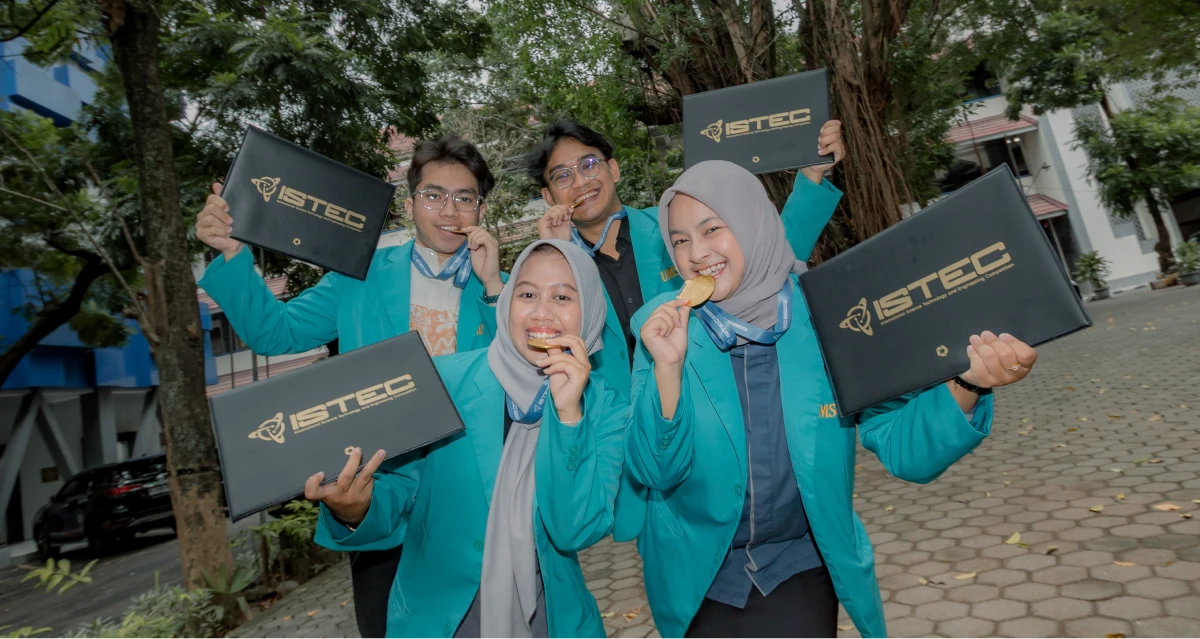
The Chitopine team poses for a photo on Campus 1 UMS, May 21, 2025, after returning to win the ISTEC gold medal. Imam Safii/UMS Public Relations
Champions in the Island of the Gods
This quartet of UMS health science students was initially frustrated when they nearly competed in a competition in Japan. “The costs were quite high, not to mention dealing with the visa,” lamented Thoriq.
They then turned their attention to another international competition held in Bali, the International Science Technology and Engineering Competition (ISTEC). After four attempts at submitting their abstract, their perseverance paid off. They became one of the 125 participants to make it to the grand final, earning the chance to showcase their pineapple leaf filter in Bali. “At first, we were hopeless,” said Hana.
In front of judges from Indonesia’s National Research and Innovation Agency (BRIN) and researchers from Malaysia, they presented the results of their four-month effort. Chitopine received special attention from the judges.
The judges emphasized the need for more diverse testing methods, for instance, testing the filter with different cigarette brands available on the market.
“BRIN suggested that we compare results using kretek cigarettes and filtered cigarettes, since nicotine levels differ between brands,” said Daffa.
On the final day of the competition, Sunday, May 11, 2025, their smiles beamed. Chitopine emerged as the champion on the Island of the Gods, winning a gold medal in the Technical Engineering category.
This achievement became a stepping stone for the team to pursue further international recognition. Hana and her team are now targeting several other international competitions, this time, with improvements and insights gained from ISTEC 2025.
They hope the cigarette filter can eventually enter the healthcare industry, particularly for smoking addiction therapy. “Our target is active smokers who want to quit. We don’t want this filter to become a reason for people to keep smoking,” Daffa hoped.
Writer: Gede Arga Adrian
Translator: Farizal Luqman Majid
Editor: Al Habiib Josy Asheva
Designer: Salsabila Kamila Wardah
Academia Star
UMS Newsletter
Nothing’s more special than reading curated news just for you.
Subscribe to the UMS Newsletter for free today.